What Are the Best Acoustic Solution Trends in 2026?

Time:2026-11-13 Author:Mason
0%

By 2026, the best acoustic solutions will do more than absorb sound. They will help people hear speech clearly, focus in busy spaces, and feel comfortable throughout the day. The question “what are trends in acoustic solutions” points to practical changes: recycled and low-impact materials, room-specific acoustic design, discreet sound masking, and systems that adjust to how spaces are used. Some are already familiar; their application is changing.

Sound expert and author Julian Treasure has said, “We are losing our listening.” His observation highlights why acoustics matter: a meeting room can look polished yet leave people straining to follow conversation. This guide explores how designers can assess reverberation, speech intelligibility, background noise, and user needs before choosing panels or technology. It also considers digital modeling and sensor-assisted controls, while treating privacy, maintenance, and material transparency as part of the design—not afterthoughts.

Not every trend deserves a place in every room. A quiet library, a lively restaurant, and a hybrid office need different acoustic choices. Results depend on room geometry, occupancy, finishes, and installation quality, so product claims should be checked against project measurements. There is no universal fix. And some solutions disappoint. The sections ahead separate useful innovations from attractive promises, with an emphasis on measurable performance and real-world trade-offs.
What Are the Best Acoustic Solution Trends in 2026?

Defining Acoustic Solutions and Their Role in 2026

Acoustic solutions are materials, layouts, and design measures that manage how sound behaves in a space. They can reduce echo, improve speech clarity, limit noise transfer, or make unwanted background sounds less intrusive. The right choice depends on the room’s purpose. A meeting room needs clear conversation, while a restaurant may benefit from softer reverberation without feeling unnaturally quiet. Not silence.

In 2026, acoustic planning is increasingly treated as part of everyday building design, rather than a fix added after complaints begin. Designers may combine ceiling absorbers, wall panels, carpeting, partitions, and quieter equipment. Each measure addresses a different problem: absorption reduces reflections inside a room, while insulation helps limit sound passing between spaces. They are not interchangeable. A padded wall may calm an echo but do little to block a neighbor’s television.

Good decisions begin with observation and, where needed, professional measurement. Notice whether speech becomes tiring near a hard table, or whether footsteps carry through an open office. Then match the treatment to the source, the room, and its users. Small changes can help. Still, results vary with construction and room layout, and attractive panels alone do not guarantee better acoustics. That part is easy to overlook.

Key Factors Driving Acoustic Design Trends

What Are the Best Acoustic Solution Trends in 2026?

Key Factors Driving Acoustic Design Trends

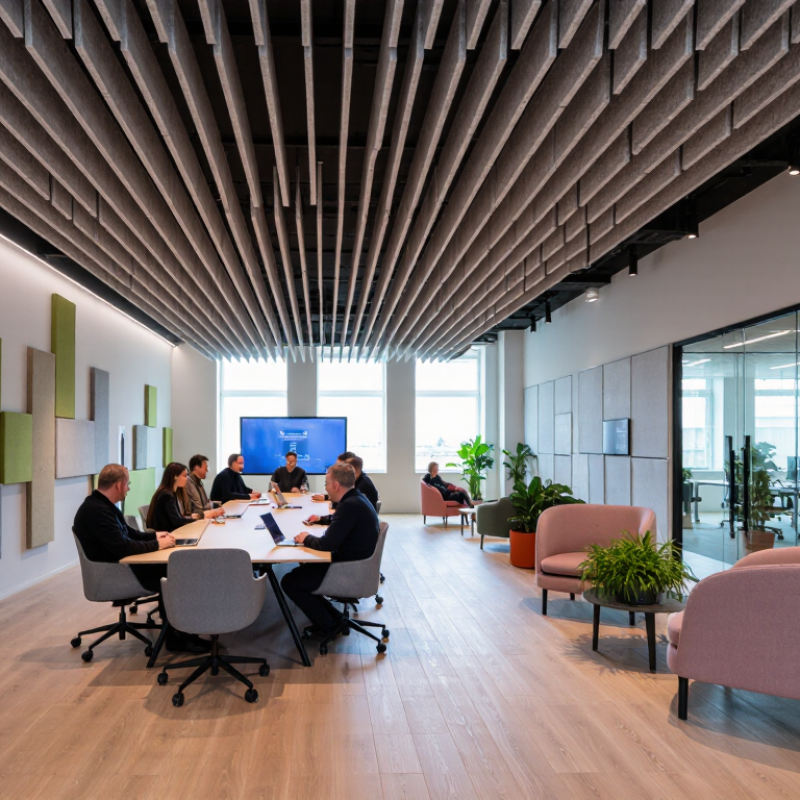
Acoustic design in 2026 is shaped by hybrid work, wellbeing priorities, and flexible room layouts. Video calls add overlapping voices to offices already filled with conversation. People need both lively collaboration areas and quiet places for focused tasks. Designers are responding with sound-absorbing ceilings, movable partitions, and smaller enclosed rooms. The challenge is balancing speech clarity with privacy, without making shared spaces feel sealed off.

Evidence helps explain the focus. Kim and de Dear’s 2013 peer-reviewed study examined 42,764 office workers across 303 buildings. It found open-plan offices performed poorly for satisfaction, especially around noise and privacy. That does not mean open layouts always fail. It does suggest that acoustic comfort deserves attention alongside lighting and furniture. Material choices matter, too: durable, lower-impact finishes can support sustainability goals, but their sound performance should be tested rather than assumed.

Tips: Map noisy zones before choosing products. Stand where calls happen; listen for speech carrying across the room. Use absorptive surfaces near sound sources, then check whether nearby work areas feel calmer. Small changes matter. And one honest caveat: a quiet room can still feel uncomfortable if it lacks fresh air or good lighting.

Emerging Materials and Technologies for Sound Control

By 2026, acoustic design is moving beyond thick foam panels. Recycled polyester felt, agricultural fibers, and mycelium-based composites are drawing attention for their lighter environmental footprint. Their performance still depends on density, thickness, and installation. A soft surface may absorb speech echoes, but it will not necessarily block traffic rumble. That distinction matters.

New tools are making sound control more measurable. Compact sensors can map noisy zones, while software helps teams test layouts before installation. Some systems adjust masking sound as room conditions change. Useful, but not magic. Sensors need sensible placement, and automated settings can feel distracting if nobody checks them. Product claims should be compared with independent test data, especially for absorption across different frequencies.

Tips: Clap in the room and listen for a sharp echo. Start with the actual problem: speech, machinery, or outside noise. Add absorptive panels near reflective walls, then measure again. Keep a clear path to exits and ventilation. Small changes matter. I would still test materials in the real space; glossy renderings rarely reveal how a room sounds at 4 p.m.

Acoustic Solutions Across Buildings and Workspaces

Across buildings and workspaces, the 2026 shift is from decorative panels toward acoustic zoning. Homes need quieter bedrooms; offices need speech privacy and clear collaboration areas. Schools benefit from controlled reverberation, while healthcare spaces often require calm rooms and intelligible conversations. The WHO/Europe report Burden of Disease from Environmental Noise (2011) estimated that environmental noise causes at least one million healthy life years to be lost annually in western Europe. That estimate concerns mainly transport noise, not indoor workplaces. Still, it shows why noise deserves attention beyond comfort. Small details matter.

In open offices, teams are combining absorptive ceilings, wall treatments, enclosed focus rooms, and carefully tuned sound masking. ISO 22955:2021 provides guidance on acoustic quality in open-plan offices, supporting designs that respond to different work activities. A useful measure is not simply how much sound a panel absorbs, but whether people can concentrate without losing access to conversation. Designers should assess background noise, reverberation, and speech privacy in the actual room. One weak spot remains: a quiet meeting room can still feel uncomfortable if ventilation hum or corridor noise carries through. Targets need testing after installation, not just attractive drawings.

What Are the Best Acoustic Solution Trends in 2026? - Acoustic Solutions Across Buildings and Workspaces

Acoustic Trend Where It Matters Practical Solutions How to Evaluate Performance Key 2026 Consideration
Hybrid-work and speech-focused room design Meeting rooms, open offices, classrooms, and shared collaboration areas Combine absorptive ceilings or wall treatments with suitable room layouts, quiet HVAC systems, and well-positioned microphones and loudspeakers. Measure reverberation time using ISO 3382 methods where appropriate; assess speech intelligibility and test conferencing audio in the finished room. Design for both in-room conversation and remote participants. Acoustic treatment should support clear speech without making the room sound unnaturally dull.
Speech privacy through zoning and sound masking Open-plan offices, healthcare settings, reception areas, and confidential meeting zones Create distance and barriers between work zones; use absorptive finishes and, where suitable, professionally commissioned sound-masking systems. Check background sound levels and uniformity, and assess speech privacy at representative listener positions. Confirm that masking does not interfere with alarms or communication. Masking is a supporting measure, not a substitute for appropriate space planning, sound isolation, or control of noise at its source.
Acoustic-first retrofit planning Existing offices, schools, apartment buildings, and renovated public spaces Survey noise paths before selecting treatments. Prioritize gaps, doors, partitions, ceiling voids, mechanical noise, and other weak points before adding finishes. Use appropriate field measurements for airborne sound insulation, impact sound, and room acoustics; compare results with the project brief and applicable local requirements. Diagnose the source and transmission path first. Adding absorptive panels can reduce room echo but will not, by itself, stop sound passing between rooms.
Low-carbon and circular acoustic materials New construction, tenant improvements, public buildings, and projects with sustainability goals Consider recycled or renewable content, durable modular products, repairable assemblies, and materials with transparent environmental documentation. Review product-specific environmental product declarations when available, alongside acoustic test data, durability, fire performance, and end-of-life options. Evaluate environmental claims together with verified acoustic performance and building-code requirements; recycled content alone does not establish overall sustainability.
Integrated control of building-services noise Offices, hotels, hospitals, residences, and spaces requiring concentration or rest Coordinate acoustic design with HVAC, plumbing, lifts, lighting, and other building systems. Use suitable equipment selection, vibration isolation, duct treatment, and careful installation. Measure background noise in the completed space under defined operating conditions; investigate tonal or intermittent noise as well as overall sound level. Early coordination can prevent noise problems that are difficult to correct after ceilings, shafts, and plant rooms are finished.
Occupant-informed monitoring and commissioning Flexible workplaces, learning environments, and buildings with changing room uses Combine occupant feedback with periodic acoustic checks. Use room-use or noise monitoring only where justified, with clear privacy safeguards and data minimization. Record room conditions, operating settings, and measurement locations; compare commissioning results with the original acoustic brief and investigate recurring complaints. Monitoring supports ongoing adjustment, but sensors do not replace professional assessment. Avoid collecting identifiable audio when environmental sound-level data is sufficient.
Multifunctional spaces with adaptable acoustics Training rooms, community buildings, multipurpose halls, and flexible offices Use movable partitions, curtains, adjustable layouts, and appropriately placed absorptive or diffusive finishes to accommodate different activities. Test representative room configurations, including partition positions and occupancy conditions; review reverberation and speech clarity for each intended use. Plan acoustic performance around the full range of activities rather than optimizing the room for only one layout or occupancy level.

Note: Acoustic targets depend on room function, occupancy, construction, and applicable regulations. Measurement methods and acceptance criteria should be selected for the specific project.

How to Assess Acoustic Performance and Select Solutions

Acoustic performance is not one number. Before choosing a solution, define the room’s main task: conversation, focused work, teaching, or recording. A classroom may need clear speech across the back row, while a meeting room may need less sound leakage through its walls. These goals call for different measures. Reverberation time helps describe how long sound persists, but it cannot show whether a neighboring room will hear a private discussion. Context matters.

Start with a baseline. Measure reverberation and background noise at several positions, then note the room’s size, occupancy, and existing finishes. A phone recording can reveal obvious echoes, but it is not a reliable substitute for calibrated measurements. Listen, too. Ask people at the far end of the room whether speech sounds clear at a normal volume. Small details matter: hard tabletops, glass partitions, and an uncovered ceiling can shape what you hear. Test again.

When comparing options, check whether a product absorbs sound, blocks transmission, or does both; these functions are not interchangeable. Review test data for the relevant frequency range and installation method, not just a headline rating. Consider cleanability, fire requirements, maintenance, and how much floor or wall space the treatment uses. A panel may perform well in a laboratory yet disappoint if gaps or poor placement reduce its effect. Real rooms are messy. Allow for that uncertainty, and confirm results after installation under ordinary use.

FAQS

What do acoustic solutions do?

They manage sound using materials, room layouts, and design changes. They can reduce echo, improve speech clarity, or limit noise between spaces. Not silence.

How are absorption and sound insulation different?

Absorption reduces reflections inside a room, such as speech echo near a hard table. Insulation helps limit sound passing between rooms. A padded wall may not block a neighbor’s television.

Which materials are being explored for acoustic design?

Recycled polyester felt, agricultural fibers, and mycelium-based composites are attracting interest. Their performance depends on thickness, density, and installation. A greener material still needs testing.

How can I identify an acoustic problem?

Listen for tiring conversations, sharp echoes, or footsteps traveling across an open office. A simple clap can reveal reflections. It is only a rough check.

Can sensors and software improve sound control?

Sensors can map noisy areas, and software can help test room layouts. Some systems adjust masking sound as conditions change. Poor placement can make them distracting.

What acoustic features help open offices?

Absorptive ceilings, wall treatments, focus rooms, and carefully tuned masking can support different work activities. People should still be able to talk when needed. Balance is tricky.

Do attractive acoustic panels guarantee a quieter room?

No. Panels may reduce echo without blocking traffic noise or machinery. Construction, room layout, and installation all affect results.

How should acoustic work be checked after installation?

Assess background noise, reverberation, and speech privacy in the actual room. Listen for ventilation hum or corridor noise. Drawings can miss those details.

Conclusion

In 2026, acoustic solutions are increasingly viewed as an essential part of comfortable, healthy, and productive spaces—not simply a way to reduce noise. The question of what are trends in acoustic solutions reflects growing attention to flexible environments, occupant well-being, and sound control that works alongside thoughtful interior design. Key influences include open-plan layouts, mixed-use buildings, remote and hybrid work, and demand for materials with lower environmental impact.

Emerging approaches combine sound-absorbing surfaces, efficient room layouts, and adaptable technologies to manage echo and unwanted noise across offices, homes, educational settings, and public buildings. Choosing a solution starts with understanding how a space is used and identifying its main acoustic challenges. Performance can then be assessed through relevant measurements, practical testing, and consideration of installation, maintenance, durability, and sustainability. The best choice balances measurable sound control with comfort, appearance, and the needs of the people using the space.

Mason

Mason

Mason is a seasoned marketing professional with a deep expertise in the company's offerings and a passion for driving brand awareness. With a strong background in digital marketing strategies, he has an innate ability to connect with diverse audiences and effectively communicate product benefits.......