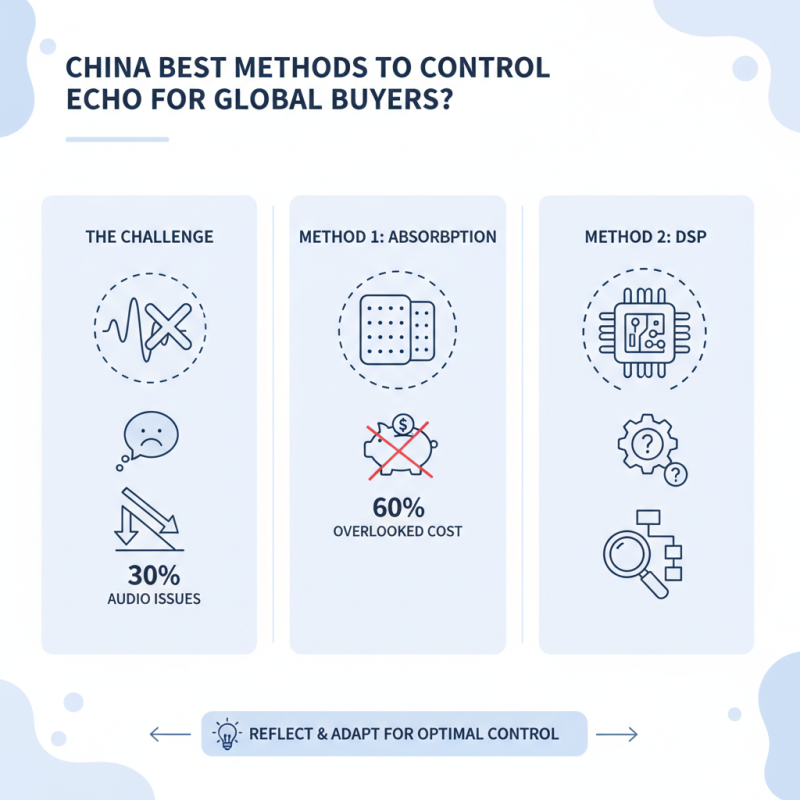
In today's fast-paced global market, efficient echo control is crucial for businesses, especially for audio-related products. Companies often ask, "what is the best way to control echo?" Recent reports indicate that around 30% of audio quality issues stem from echo interference. This challenge not only affects communication but also impacts customer satisfaction and overall sales performance.
Echo control methods vary significantly across different environments. For instance, sound absorption materials are frequently highlighted in professional studies as effective tools. However, while materials like acoustic panels can reduce echo, their implementation can be costly. Research suggests that up to 60% of companies overlook this expense, leading to suboptimal sound quality. It's essential for global buyers to weigh these costs against the benefits.
Moreover, technical solutions, such as digital signal processing, prove effective but require specialized knowledge to implement. These methods can be complex and may introduce new challenges. Buyers must carefully evaluate their options and remain adaptable. In navigating these choices, reflecting on past experiences helps refine strategies for optimal echo control.
In Chinese manufacturing facilities, controlling echo is crucial for maintaining a productive environment. High ceilings and hard surfaces can amplify sound, affecting communication and safety. Effective echo control not only enhances worker comfort but also boosts efficiency.
One effective method is using acoustic panels. These can be installed on walls and ceilings to absorb sound. They come in various designs, allowing for both function and aesthetics. Additionally, adding carpets or rubber flooring can reduce floor reflection, further minimizing echo.
Tips: Consider strategically placing sound-absorbing materials in high-noise areas. Regular maintenance of these materials is essential to ensure long-term effectiveness. Not all solutions work universally; adapting to your facility's unique acoustics is key. Explore various options and continuously assess their impact on sound control.
Echo control is crucial for product quality in Chinese industries. Uncontrolled echo can distort sound, impacting communication and production. For global buyers, ensuring the best echo control methods is vital. Noise levels can affect worker efficiency, leading to mistakes and lower quality.
Tips: Invest in acoustic treatments like sound-absorbing panels. They help reduce echo in manufacturing environments. Regular assessments of sound levels can highlight problem areas. Also, include staff training on noise management for improved outcomes.
Many factories face challenges in echo control. In larger spaces, sound bounces off walls and equipment, causing distractions. Workers may struggle to focus. Though some methods are effective, continuous reflection on practices is necessary. Collaboration with acoustic experts can provide tailored solutions. It’s not a one-size-fits-all situation; every space requires unique adjustments.
In recent years, China has significantly advanced its methods to control echo in various environments. Technological innovations play a key role in reducing echo, especially in large public spaces and industrial facilities. For instance, the introduction of sound-absorbing materials has helped enhance acoustic comfort. These materials are designed to minimize reverberation, creating clearer sound environments.
Another notable innovation is the use of digital signal processing technology. This allows for real-time monitoring and adjustment of sound waves. The systems can adapt to different acoustic conditions, which is particularly useful in dynamic settings. However, these technologies are not infallible. Dependence on advanced equipment can sometimes neglect the importance of proper architectural design.
Furthermore, training personnel in echo control techniques is crucial. Many installations lack trained professionals who understand the acoustic properties of spaces. While China boasts impressive technological advancements, it must also value expertise in practical applications. Continuous improvement in both technology and training remains essential for effective echo reduction.
When considering methods to control echo, global buyers must evaluate cost-effectiveness. Various techniques exist, yet the right choice largely depends on the specific space and budget. Some solutions, like foam panels, are affordable and easy to install. Others, such as acoustic ceilings, can be more expensive but offer superior sound quality.
Tips: Consider testing different materials in small areas before committing to a larger installation. It's critical to understand that not all solutions fit every environment. Some methods may require trial and error, particularly in rooms with unique acoustics.
Moreover, investing in professional consultations can provide valuable insights. Experts can guide buyers to the most suitable options, balancing quality and cost. However, professional advice may not always be feasible within tight budgets. Each buyer must weigh the potential benefits against their financial limits. Remember, a well-informed decision can lead to better sound management in the long run.
In recent years, Chinese companies have focused on innovative methods to control echo in various settings. One notable case is a large conference center that faced significant echo issues due to its design. Engineers implemented sound-absorbing panels on walls and ceilings. These materials significantly reduced echo and improved sound clarity during meetings. The feedback was overwhelmingly positive. Participants noted how much easier it was to communicate.
Another successful example comes from a classroom environment. In a school with high ceilings, teachers struggled to attract students' attention. Experts introduced acoustic ceiling tiles and carpeted floors to absorb sound. The results were impressive. Teachers reported enhanced student engagement and less distraction during lessons. This approach demonstrated how tailored solutions can transform learning spaces.
However, some implementations have faced challenges. Not all materials perform as expected, leading to continued echo problems. Ongoing adjustments and regular evaluations are necessary to ensure effectiveness. The learning curve has been steep, prompting many to rethink their strategies. In echo control, flexible and adaptive methods often yield the best long-term outcomes.
: Echo control enhances communication, safety, and worker comfort, boosting overall efficiency.
Acoustic panels on walls and ceilings help absorb sound, while carpets reduce floor reflection.
Strategically position them in high-noise areas for maximum impact.
Yes, regular maintenance ensures long-term effectiveness of sound-absorbing materials.
Buyers must evaluate affordability and effectiveness for their specific space and budget.
No, some solutions may not fit every environment and require adaptation.
Testing different materials in small areas is advisable before larger installations.
Yes, expert advice can guide buyers to suitable, cost-effective options.
Sometimes, professional consultations may not fit tight budgets, requiring careful consideration.
Yes, trial and error may be necessary to find effective solutions in unique acoustics.
The article titled "China Best Methods to Control Echo for Global Buyers?" delves into the various strategies and practices employed in Chinese manufacturing facilities to effectively manage echo. It explores best practices for echo control, emphasizing the significant impact this control has on product quality across various industries. Additionally, the piece highlights innovative technologies that have emerged in China for echo reduction, showcasing their effectiveness.
Moreover, it evaluates the cost-effectiveness of different echo control methods, making it easier for global buyers to make informed decisions. Case studies of successful implementations in China serve as compelling examples of what is the best way to control echo, demonstrating that with the right strategies and technologies, both efficiency and product quality can be enhanced significantly.

Dubuild Panel