China Top Meeting Room Acoustic Panels for Clearer Sound

Time:2026-10-02 Author:Charlotte
0%

Clear communication is the foundation of an effective meeting room. Yet speech often disappears beneath reverberation, HVAC noise, and hard reflective surfaces. The Gensler Research Institute’s 2023 Global Workplace Survey highlights the continuing importance of spaces that support focused work and collaboration. Acoustic performance is not a luxury. It directly affects whether people hear instructions, names, and decisions correctly.

For businesses asking how to improve sound clarity in meeting rooms, the solution begins with measurement. ISO 3382-2:2008 provides methods for evaluating reverberation time in ordinary rooms. Shorter reverberation usually produces sharper speech. However, adding one decorative panel rarely fixes an entire room. Wall coverage, ceiling absorption, room shape, background noise, and seating position must work together. Julian Treasure, sound consultant and author, states, “The human voice is the instrument we all play.” His observation explains why clear speech depends on both speaker behavior and the surrounding acoustic environment.

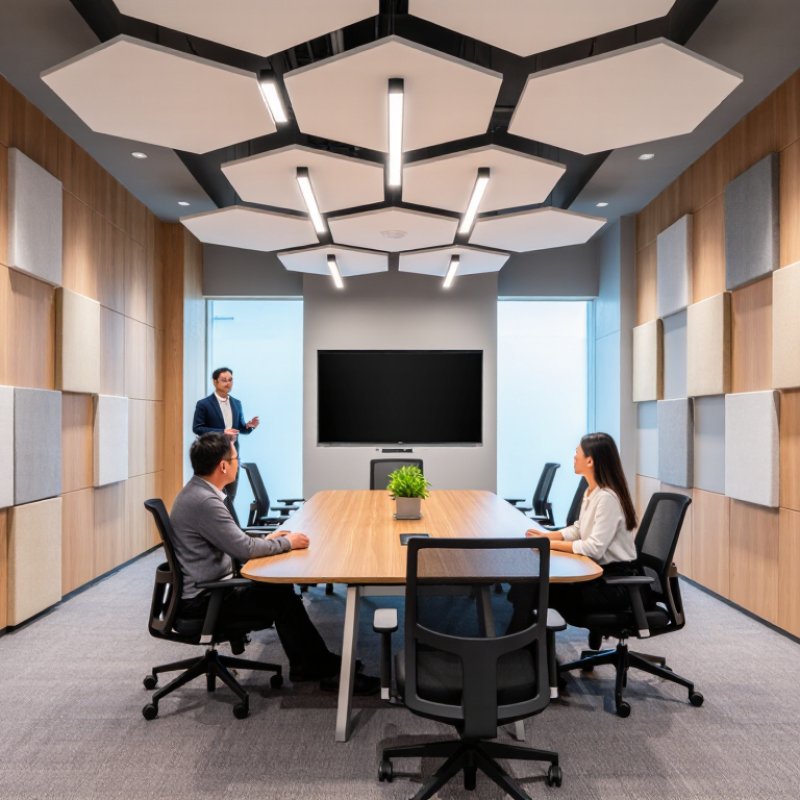
China’s leading meeting room acoustic panels can support this balance through PET felt, fabric-wrapped mineral wool, or perforated wood systems. A panel beside the presenter can reduce early reflections. Ceiling clouds can control sound above a conference table. Soft surfaces near glass walls can prevent harsh echo. Still, product claims deserve careful review. Check absorption ratings, test conditions, fire performance, mounting details, and independent documentation. The best choice is not always the thickest panel. It is the system that fits the room’s measured problems. This article examines China’s top solutions for clearer sound, while acknowledging one uncomfortable truth: acoustic design is never completely automatic.
China Top Meeting Room Acoustic Panels for Clearer Sound

What Are Meeting Room Acoustic Panels?

China Top Meeting Room Acoustic Panels for Clearer Sound

What Are Meeting Room Acoustic Panels?

Meeting room acoustic panels are porous materials designed to absorb reflected sound. They reduce echoes from walls, ceilings, and hard tables. Common cores include mineral fiber, polyester fiber, and fiberglass. A fabric surface protects the core and supports interior design.

In practice, panels make speech more defined. A participant at the far end should hear consonants, not only loud vowels. The International Organization for Standardization uses reverberation time, or RT60, to evaluate room acoustics under ISO 3382-2. Many small meeting rooms perform better near 0.4–0.6 seconds, though room volume and occupancy change the target. The number is useful, not absolute.

The 2023 Leesman Index identifies noise control as a major workplace experience concern across its global survey data. This matters during hybrid meetings, where microphones capture reflections and keyboard noise together. Panels should cover first-reflection points, especially beside speakers and above the table. Ceiling clouds can help when walls are already occupied. Do not treat them as magic. They will not block voices through glass or thin partitions; that requires mass, sealing, or separate sound insulation. A common mistake is installing too few panels. Another is covering every surface and creating a dull, uncomfortable room. A measured acoustic test is wiser than visual guesswork, although many projects still skip it.

How Acoustic Panels Improve Speech Clarity

Clear speech is the real test of meeting room acoustics. In a reflective room, voices bounce from glass, walls, and a hard table. These echoes blur consonants, especially during online calls. Well-placed acoustic panels absorb part of the reflected sound. They help the direct voice reach each seat more clearly. From practical room checks, panel position often matters more than panel quantity. Ceiling clouds can reduce overhead reflections, while wall panels control side-wall flutter. Results depend on room size, surface materials, and panel thickness. No single layout works everywhere.

Tips: Clap near the table and listen for a sharp ring. Record a short conversation from the farthest chair. If words sound distant, add absorption near strong reflection points, not only behind the speaker. Keep microphones away from noisy ventilation. Test again after installation.

Good acoustics support better decisions, not just quieter rooms. Participants interrupt less when they catch complete phrases. Remote listeners also benefit from reduced reverberation and steadier microphone levels. However, excessive absorption may make a room feel unnaturally dull. A balanced design should preserve comfortable energy while limiting echo. Measure before and after from the same speaking position. A simple comparison can reveal more than visual confidence. Ask users for feedback, because technical readings may miss fatigue or listening difficulty.

Key Materials and Designs for Meeting Rooms

China Top Meeting Room Acoustic Panels for Clearer Sound

Meeting room panels depend on more than appearance. Material selection controls how speech travels, reflects, and fades. Recycled PET felt offers lightweight absorption and flexible color options. Mineral wool panels usually provide stronger mid- and high-frequency control when properly covered. Perforated wood adds a warmer visual finish, but its performance depends on the backing layer and cavity depth.

Design should follow the room’s actual problems. Wall panels near speakers and meeting participants can reduce early reflections. Ceiling clouds help control sound above a long conference table. Thicker panels or corner treatments may be needed when voices sound boomy. Soft fabric surfaces work well for speech, while decorative hard surfaces can create unwanted echoes. Small changes matter.

Real projects need measured evidence. Ask manufacturers for independent acoustic test data, fire ratings, formaldehyde or VOC information, and installation instructions. Check the test method, not only the absorption number. A high rating in a laboratory may not match a crowded glass-walled room. Microphone placement, ventilation noise, and door gaps also affect clarity. Panels cannot solve every acoustic problem.

Some designs look excellent but absorb too little sound. That mistake is easy to make. A balanced specification considers thickness, density, spacing, coverage, and maintenance. Before ordering large quantities, test sample panels inside the meeting room. Listen from the far seat. Then review the decision with an acoustic professional.

How to Choose the Right Acoustic Panels in China

Choosing acoustic panels in China should begin with the room’s purpose, not a catalog color. During site checks, I measure room size, wall finishes, occupancy, and HVAC noise. ISO 3382-1 identifies reverberation time as a core acoustic indicator. Speech rooms often perform well near 0.6–0.8 seconds, depending on volume and use. Shorter is not always better. The World Health Organization’s Guidelines for Community Noise recommend about 35 dB(A) in classrooms during teaching. Echo control alone cannot solve excessive background noise.

Ask suppliers for independent test reports based on ISO 354, GB/T 20247, or ASTM C423. These standards measure sound absorption under controlled conditions. An NRC near 0.80 suggests strong average absorption across common test frequencies. It does not guarantee equal performance in every room. Check thickness, density, mounting gaps, edge treatment, fire classification, formaldehyde emissions, and cleaning resistance. Request full test curves, not only one impressive number.

Placement matters as much as the panel itself. Install absorption near first-reflection points, above desks, and on the rear wall when speech clarity is the priority. Ceiling clouds can reduce vertical reflections in high rooms. Leave some reflective area for natural liveliness. I once specified too much absorption in a small meeting room. Speech became dull, although the reverberation result looked excellent. That mistake still deserves review. Measure the finished room after installation, because furniture and people change the result.

Installation and Maintenance Considerations

Selecting China-made meeting room acoustic panels is only part of achieving clearer speech. Installation quality often decides the result. Measure the room’s reverberation, wall area, ceiling height, and main speaking positions before ordering. Panels should cover reflective surfaces near presenters and conference tables, not simply fill one wall. Leave suitable air gaps behind porous panels when the acoustic design requires them. This can improve low-frequency absorption. Use mechanical fasteners in busy rooms, especially where panels may receive accidental impact. Adhesives alone can be unreliable on dusty or uneven walls. Check the substrate first.

Fire performance, moisture resistance, and indoor air quality also deserve documented verification. Ask for test reports that match the actual panel construction, not a similar sample. Keep ventilation grilles, lighting, cameras, and access panels unobstructed. Small alignment errors remain visible under strong ceiling lights. They also suggest rushed workmanship.

Maintenance should be simple and scheduled. Vacuum fabric surfaces gently with a soft brush attachment every few months. Remove marks with a lightly damp, clean cloth, then allow the surface to dry naturally. Avoid soaking the core. Inspect corners, mounting points, and fabric tension during routine room checks. Replace damaged sections rather than covering them with new layers. One practical mistake is cleaning too aggressively; it can flatten fibers and create pale patches. Acoustic performance may remain acceptable, but the room will look neglected. Recheck speech clarity after furniture changes, because a large table, glass partition, or new screen can alter sound reflections.

China Top Meeting Room Acoustic Panels for Clearer Sound — Installation and Maintenance Considerations

The chart shows representative sound absorption coefficients at 500 Hz, a key mid-frequency range for speech intelligibility. Thicker panels and a rear air gap generally improve absorption, especially when panels are installed on reflection points such as side walls and ceilings. Values are typical reference figures; verify final performance with the product’s certified laboratory data.

For maintenance, vacuum or gently brush fabric surfaces regularly, remove stains with a suitable low-moisture cleaner, and inspect mounting hardware periodically to keep panels secure and effective.

FAQS

What are meeting room acoustic panels?

They are porous materials that absorb reflected sound from walls, ceilings, and hard tables. Common cores include mineral fiber, polyester fiber, and fiberglass. A fabric surface protects the core. Speech becomes clearer.

How do acoustic panels improve meeting conversations?

They reduce echoes and make consonants easier to hear. A person at the far end should hear words, not only loud vowels. This helps microphones capture cleaner speech during hybrid meetings.

Where should acoustic panels be installed?

Place them near first-reflection points beside speakers and above the meeting table. Rear-wall panels can improve speech clarity. Ceiling clouds help control reflections in taller rooms. Do not cover every surface.

Can acoustic panels block voices from another room?

No. They mainly absorb sound inside the room. Glass and thin partitions still allow voices through. Blocking sound requires mass, sealing, or separate sound insulation.

How many panels does a meeting room need?

The answer depends on room size, furniture, occupancy, and wall finishes. Too few panels leave strong echoes. Too many can make speech dull and uncomfortable. Measure the finished room when possible.

What should buyers check when choosing acoustic panels?

Request full absorption test curves, not one attractive number. Check thickness, density, mounting gaps, fire performance, emissions, and cleaning resistance. A high average rating does not guarantee equal performance everywhere.

How should acoustic panels be installed?

Check the wall substrate before installation. Mechanical fasteners are safer in busy rooms. Adhesives may fail on dusty or uneven walls. Leave air gaps when the acoustic design requires them. Keep lights, cameras, and vents clear.

How should fabric acoustic panels be maintained?

Vacuum the fabric gently every few months with a soft brush attachment. Remove marks using a lightly damp cloth. Do not soak the core. Inspect corners and mounting points. Replace damaged sections.

What common mistake should meeting room designers reconsider?

I once specified too much absorption in a small room. The reverberation result looked excellent, but speech became dull. That decision still needs review. Furniture changes can also alter reflections, so clarity should be checked again.

Conclusion

Meeting room acoustic panels are purpose-designed solutions that control unwanted reverberation, echoes, and background noise, helping conversations remain clear and comfortable. By absorbing or diffusing sound energy, they reduce the overlap between speakers’ voices and improve speech intelligibility during meetings, presentations, and video conferences. Understanding how to improve sound clarity in meeting rooms begins with evaluating room size, surface materials, noise sources, and the number of people using the space.

Common panel materials include acoustic fabric, mineral fiber, recycled polyester, wood, and perforated surfaces, each offering different levels of absorption, durability, and visual appeal. When choosing panels in China, consider acoustic performance, fire safety, environmental requirements, design compatibility, budget, and supplier support. Proper placement on walls and ceilings is essential, especially near reflective surfaces. Installation should be handled carefully to avoid gaps, while regular dust removal and periodic inspections can help maintain both appearance and acoustic effectiveness over time.

Charlotte

Charlotte

Charlotte is a seasoned marketing professional with a deep understanding of the company's portfolio and a passion for elevating its presence in the market. With a keen eye for detail and a commitment to excellence, she ensures that our professional blog is regularly updated with insightful articles......