For buyers in China, a room’s appeal is not only what they see. It is also what they hear. Traffic through a closed window, footsteps above, or voices from the next room can change how comfortable a property feels. That is why “what is the importance of acoustic design” is a practical buying question, not just a technical one. Good acoustic planning can help limit unwanted noise and make speech easier to understand. It may also support privacy in homes, offices, hotels, and shared spaces.
Sound consultant Julian Treasure has said, “Sound affects us physiologically, psychologically, cognitively, and behaviorally.” His observation helps explain why noise deserves attention during a property viewing. Buyers can listen for echoes in an empty room, test doors and windows, and notice whether mechanical systems hum nearby. These checks offer useful clues, but they are not a substitute for professional assessment. A quiet viewing at midday may not reflect conditions at night or during busy hours. And finishes can mislead: a soft rug may reduce reflections without blocking noise from outside. Acoustic quality is not always obvious. It can be easy to overlook. China’s cities and building types vary widely, so one checklist cannot fit every purchase. The best decision comes from matching acoustic expectations to the location, construction, and intended use. Sometimes, the honest answer is that more testing is needed.
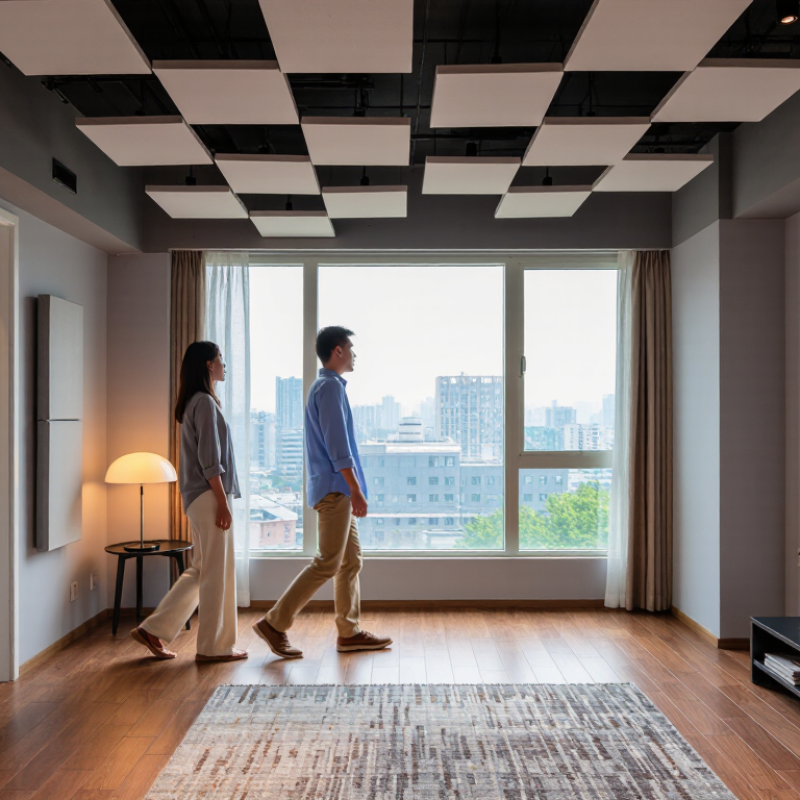
Acoustic design is the planned control of sound in a space or product. It considers how sound travels, reflects, and reaches the listener. The goal is not always silence. A home, classroom, or office may need clear speech while limiting distracting noise. Small choices matter, such as a door seal, a soft ceiling panel, or a washing machine’s vibration reaching the floor.
In buildings, designers manage sound between rooms and from outside. Dense urban settings in China can make this especially relevant, particularly in apartments near roads or shared corridors. Heavy walls may reduce some noise, while curtains, rugs, and absorbent panels can soften echoes indoors. These solutions do different jobs. A quiet room can still have poor acoustics if speech sounds hollow or hard to understand.
Products also have acoustic design. A fan, refrigerator, or desk lamp may produce a low hum, clicks, or vibration during use. Designers can adjust the motor, casing, or contact points to reduce unwanted sound. Buyers can listen in person when possible, since technical descriptions may not reflect a product’s sound in a small room. I would not treat one material as a complete fix; installation and room layout can change the result. That part is easy to overlook.
| Acoustic Design Area | What It Means | Useful Metric | How to Read the Data | Why Buyers Should Care | Relevant Reference |
|---|---|---|---|---|---|
| Sound insulation between rooms | How well a wall, floor, door, or partition reduces airborne sound travelling from one space to another. | Rw or DnT,w (dB) | These are weighted sound-insulation ratings. In general, a higher rating indicates better airborne sound insulation; check that the rating and test conditions suit the intended application. | Important for privacy and comfort in apartments, hotels, offices, and meeting rooms. A product rating alone does not guarantee the same performance after installation. | ISO 16283-1 for field measurement; ISO 717-1 for rating. China’s mandatory GB 55016-2021 sets building-environment requirements; applicable project requirements should be checked. |
| Impact sound through floors | Footsteps and other impacts can make a floor structure vibrate and transmit noise into rooms below or nearby. | L’nT,w (dB) | This is a weighted field rating for impact sound transmission. A lower value generally indicates better impact-sound insulation. | Useful when comparing floor assemblies, resilient layers, and ceiling systems for multi-storey housing or other buildings with occupants above and below one another. | ISO 16283-2 for field measurement; ISO 717-2 for rating. |
| Outdoor noise at the building | Traffic, aircraft, rail, and other environmental sounds can affect indoor comfort, particularly in bedrooms and other quiet spaces. | LAeq,T, Lden, Lnight (dB) | These describe sound levels over defined periods. WHO’s 2018 European-region guidance recommends reducing road-traffic exposure below 53 dB Lden and 45 dB Lnight. These are health-based recommendations for that region, not Chinese statutory limits. | Buyers can use site noise information to assess façade, window, ventilation, and room-layout needs before committing to a property or design. | WHO, Environmental Noise Guidelines for the European Region (2018). Check local Chinese regulations and project requirements separately. |
| Room reverberation and speech clarity | Room acoustics describe how sound reflects and decays inside a space. Excessive reverberation can make speech harder to understand. | RT (reverberation time); STI | RT describes sound decay in a room; STI assesses speech transmission. Appropriate targets depend on room size, use, occupancy, and design. | Relevant to classrooms, restaurants, offices, auditoriums, and homes with open-plan spaces. Absorptive finishes may improve room sound without necessarily blocking noise between rooms. | ISO 3382 series for reverberation-time measurement; IEC 60268-16 for speech transmission index methods. |
| Sound absorption of interior products | Ceiling panels, wall panels, and other finishes can absorb some sound energy and reduce reflections within a room. | αw or NRC | These are sound-absorption ratings derived using specified test methods. Higher values generally indicate greater absorption under the relevant rating system; compare like-for-like test data. | Useful when selecting finishes for speech comfort or reverberation control. Absorption is not the same as sound insulation and does not by itself prevent sound from passing through a wall. | ISO 354 and ISO 11654; ASTM C423 is another commonly used test method. |
| Windows and façade sound insulation | The window-and-façade assembly affects how much outdoor noise enters an occupied room. | Rw(C; Ctr) (dB) | Rw is a weighted sound-insulation rating. The Ctr adaptation term is relevant to spectrum types that include substantial low-frequency sound, such as many road-traffic situations. Compare ratings tested under compatible conditions. | Helps buyers assess windows in relation to the actual noise source. Frame, seals, installation, ventilation openings, and flanking paths also affect real-world performance. | ISO 10140 series for laboratory measurement; ISO 717-1 for rating. |
| Noise from building equipment and products | Fans, pumps, air-conditioning units, and appliances can produce sound that affects nearby users or occupants. | LwA (sound power); LpA (sound pressure) | Sound power describes the source’s acoustic output; sound pressure describes sound at a particular position and depends on distance and surroundings. Do not treat the two values as interchangeable. | Ask for the measurement conditions and installation context when comparing equipment. Location, mounting, vibration isolation, and duct design can influence the sound heard in a room. | ISO 3744 provides a method for determining sound power levels from sound-pressure measurements. |
Buyer note: Acoustic ratings depend on test methods, specimen construction, installation, and site conditions. Confirm the applicable Chinese code, project specification, and test report before comparing products or buildings.
Homes may face elevated roads, busy streets, lift shafts, or pump rooms. Traffic, footsteps, and machinery can affect sleep and calls.
Listen for bus brakes, scooters, hallway voices, plumbing, and footsteps. Check both the bedroom and shared walls.
Close the bedroom window and listen. Visit in the evening or during rush hour, if possible. One quiet visit can mislead.
Check window seals, doors, wall construction, and vibration isolation near mechanical equipment. Notice which side of the home faces traffic.
Yes. Rugs, curtains, and bookcases can soften echoes, but they cannot fix every structural issue. A furnished room may still transmit noise.
Ask whether testing was done on site and what it measured. Check for airborne sound and impact noise, such as footsteps.
Requirements and enforcement can vary by city and project. Confirm applicable standards with a qualified local designer or inspector.
Yes, their experience can reveal recurring noise. One apartment cannot represent every unit, though. That limitation matters.
Acoustic design shapes how sound is controlled in buildings and products, influencing privacy, clarity, and the overall experience of a space. In China, dense cities, busy transport networks, mixed-use developments, and varied building conditions make noise management a practical concern. Buyers should consider factors such as sound insulation, absorption, reverberation, speech privacy, and the intended use of each space, while also checking how solutions perform under relevant local requirements.
Understanding what is the importance of acoustic design means looking beyond noise reduction alone. Well-planned acoustics can support comfort, rest, communication, health, and productivity in homes, workplaces, schools, and public settings. When comparing options, buyers can review test data, performance ratings, material suitability, installation needs, durability, and maintenance. Matching measurable acoustic performance to the space’s real needs helps buyers make informed choices and avoid relying on appearance or broad claims alone.

 Dubuild Panel